
July 26, 2026
7 Water Softener Alternatives for Hard Water
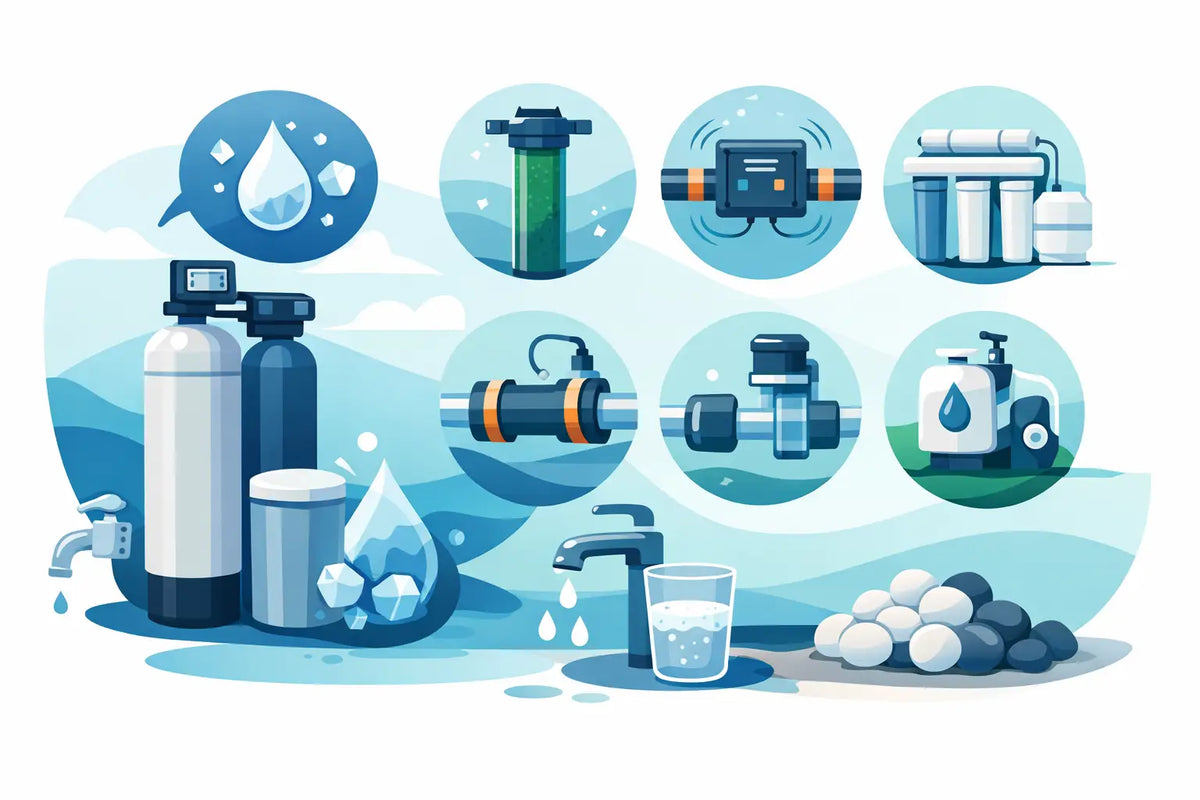
White crust around faucets, spots that survive the dishwasher, stiff laundry, and a water heater that seems to work harder than it should all point to the same concern: hard water. But traditional salt-based softening is not the only path forward. The best water softener alternatives depend on whether you need to remove hardness minerals, reduce scale buildup, improve drinking water, or solve a separate issue such as chlorine, sulfur, iron, or PFAS.
A system should be selected for the water problem, not simply because it is labeled a whole-house solution. That distinction protects your plumbing, your appliances, and your budget.
First, Know What a Traditional Softener Does
A conventional ion-exchange water softener removes calcium and magnesium, the minerals responsible for hardness. It does this by exchanging those minerals for sodium or potassium. The result is genuinely softened water: less scale, better soap performance, softer-feeling laundry, and stronger protection for fixtures and water-using appliances.
That performance is hard to match when hardness is severe. However, some homeowners prefer to avoid salt, do not have a convenient drain for regeneration, want lower maintenance, or are focused on drinking-water contaminants rather than hardness. In those cases, an alternative may be a better fit.
The key is to separate hardness removal from scale prevention. Many alternatives condition minerals so they are less likely to form hard deposits, but they do not remove calcium and magnesium from the water. A simple hardness test and, when needed, a broader laboratory water analysis make the choice much clearer.
Water Softener Alternatives That Solve Specific Problems
1. Salt-Free Water Conditioners
Salt-free conditioners are the closest alternative for households that want scale control without salt bags, regeneration cycles, or wastewater discharge. Most use template-assisted crystallization, often called TAC, to change the way hardness minerals behave. Calcium remains in the water, but it is less likely to attach to pipes, heating elements, fixtures, and appliance components as hard scale.
This is a strong option for municipal water with moderate hardness, especially where low maintenance and salt-free operation are priorities. It can help protect tankless water heaters, dishwashers, and water heaters from new scale buildup.
There are trade-offs. Salt-free systems do not produce the slippery feel associated with softened water, and they may not improve soap lather or laundry performance to the same degree as ion exchange. They also do not remove existing hardness minerals, iron, manganese, sediment, chlorine, or contaminants. For very hard water, a traditional softener may still be the more reliable choice.
2. Reverse Osmosis for Better Drinking Water
Reverse osmosis is not a whole-house softener replacement, but it is one of the most valuable alternatives when your main concern is the water you drink and cook with. An under-sink reverse osmosis system uses a membrane to reduce a broad range of dissolved contaminants, including many minerals, salts, and other substances that can affect water quality.
For families concerned about drinking-water contaminants, taste, odor, lead, or PFAS reduction, reverse osmosis offers protection at the point where it matters most: the kitchen faucet. It is commonly paired with a whole-house system rather than used in place of one.
RO does have practical considerations. It produces water more slowly than a standard faucet filter and typically sends some water to drain during purification. Its filters and membrane require scheduled replacement. On very hard water, pretreatment can help protect the membrane and extend system life.
3. Whole-House Carbon Filtration
If chlorine smell, chemical taste, dry skin, or unpleasant shower water is your biggest complaint, whole-house carbon filtration may solve the problem more directly than a softener. Carbon media can reduce chlorine and certain organic compounds, improving water throughout the home for drinking, bathing, cooking, and laundry.
Carbon filtration does not soften water or stop mineral scale on its own. Still, it is often the right first system for city-water households that mistake chlorine-related dryness or taste issues for hard-water problems. A properly sized whole-house filter can also be combined with a salt-free conditioner or water softener when both chlorine and hardness are present.
System sizing matters. A filter that is too small for the home's flow rate may cause pressure loss or provide limited contact time. Household size, number of bathrooms, peak flow demand, and local water conditions should guide the specification.
4. Sediment and Iron Filtration for Well Water
Well water can create stains, buildup, and appliance problems that look like hardness but have a different source. Sediment, iron, manganese, sulfur bacteria, and low pH can each require a specific treatment approach. An iron filter, oxidation system, backwashing media filter, or sediment prefilter may be more useful than a softener alone.
Iron commonly leaves orange or brown stains in toilets, sinks, and laundry. Manganese can leave darker stains, while hydrogen sulfide creates the familiar rotten-egg odor. These issues should usually be addressed before a water softener or reverse osmosis system because they can foul media and reduce performance.
Some well-water systems combine iron reduction and hardness treatment, but the design depends on water chemistry. A well-water test should include hardness, iron, manganese, pH, sulfur, total dissolved solids, and bacteria when appropriate. Guessing can lead to equipment that treats one symptom while leaving the root problem behind.
5. Ultrafiltration Systems
Ultrafiltration uses a fine membrane to reduce sediment, cysts, bacteria, and other larger particles without the same level of dissolved-mineral reduction provided by reverse osmosis. It can be a practical choice where water is microbiologically questionable or contains fine particulate matter, but the homeowner wants to retain minerals and avoid RO wastewater.
This technology does not remove hardness. It works best as part of a targeted treatment plan, particularly for homes using well water or rainwater collection systems where physical contaminants are the concern. Depending on the source water, ultrafiltration may be paired with carbon filtration, UV disinfection, or sediment reduction.
6. UV Water Purification
UV systems use ultraviolet light to inactivate microorganisms such as bacteria and viruses. They are especially valuable for private wells, rural properties, and applications where microbiological safety is a priority. Unlike chemical disinfection, UV does not add anything to the water or change its taste.
UV is not a filter and does not address hardness, sediment, iron, chlorine, or PFAS. Water must also be clear enough for the light to work effectively, which is why sediment filtration is often installed ahead of a UV unit. For a well with bacterial concerns, UV can be a critical layer of protection, but it should be chosen based on water testing and flow requirements.
7. Point-of-Use Filters for Focused Improvements
Under-sink filters, countertop systems, refrigerator filters, and shower filters are practical alternatives when the concern is limited to one area. A shower filter may reduce chlorine exposure during bathing, while an under-sink carbon filter can improve taste and odor at a drinking-water faucet.
Point-of-use treatment is usually more affordable upfront than a whole-home system, but it does not protect plumbing, fixtures, or appliances from hard-water scale. It is best for renters, smaller budgets, or households with a clearly defined drinking or bathing concern.
How to Choose the Right Alternative
Start with the symptoms, then verify them with testing. If scale is your only concern and hardness is moderate, a salt-free conditioner can be a sensible, low-maintenance option. If you want truly softened water for laundry, soap performance, and severe scale protection, ion exchange remains the standard.
If the concern is drinking water, an under-sink reverse osmosis system may provide more meaningful protection than treating every gallon entering the home. If chlorine is the issue, consider whole-house carbon filtration. If your home uses a private well, test before buying anything: iron, sulfur, bacteria, and pH often determine the treatment sequence.
For businesses, the decision also includes daily water demand, peak flow, equipment protection, and required water quality. A restaurant may need scale control for ice machines and steam equipment, while a lab or facility may require reverse osmosis, ultrafiltration, or custom pretreatment. Commercial systems should be sized around real operating conditions, not residential assumptions.
Can You Combine Water Treatment Systems?
Often, the best answer is not one product but a coordinated system. A common municipal-water setup includes sediment filtration, carbon filtration, a salt-free conditioner or softener, and reverse osmosis at the kitchen sink. A well-water setup may use sediment reduction, iron or sulfur treatment, softening or conditioning, and UV disinfection.
Order matters. Pretreatment protects downstream equipment, and every component should be sized to maintain adequate flow and service life. Adding systems without a plan can create pressure issues, unnecessary maintenance, and disappointing results.
Choosing between water softener alternatives should feel straightforward once the water problem is defined. PureWaterGuys can help match your test results, household demand, and treatment goals to a system that protects the water you use every day.