
August 19, 2026
Water Conditioners: What They Do for Hard Water
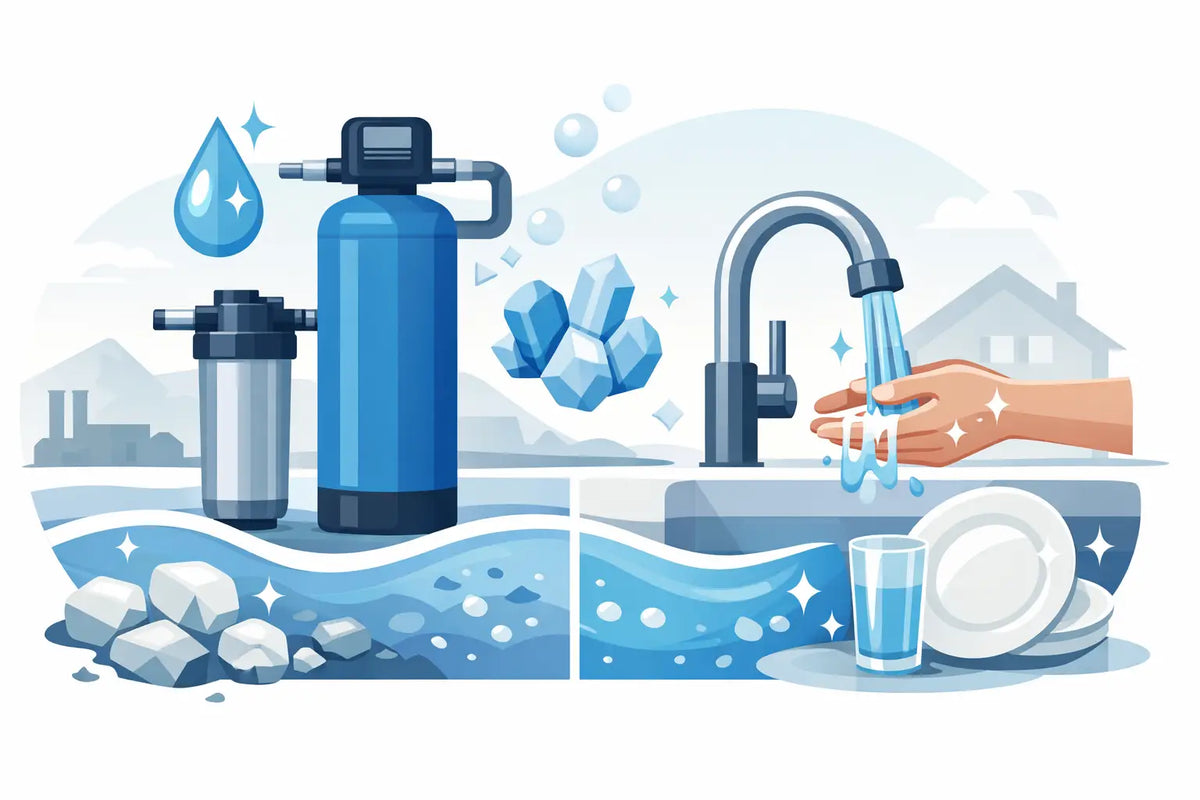
A white crust around faucets, cloudy glassware, and a water heater that seems to work harder every year are not just cleaning frustrations. They are common signs of hard water scale. Water conditioners can help protect plumbing, fixtures, and water-using appliances without the salt, brine discharge, or regeneration cycle associated with traditional water softeners. The right choice, however, depends on what is actually in your water and what you need the system to accomplish.
What Are Water Conditioners?
Water conditioners are treatment systems designed to change how hardness minerals behave in water. Hard water contains dissolved calcium and magnesium. When heated or allowed to evaporate, those minerals can form scale on heating elements, inside pipes, on shower doors, and throughout appliances.
A salt-free conditioner typically does not remove calcium or magnesium from the water. Instead, it uses a conditioning process to help keep those minerals from attaching as stubborn scale. This distinction matters. Your water may still test as hard after conditioning because the minerals remain present, but their tendency to build up on surfaces can be reduced.
For many homeowners, that is exactly the goal: less scale maintenance and better appliance protection without adding sodium to the water supply. But if you want the slippery feel of softened water, easier soap lathering, or a measurable reduction in hardness grains, a conventional ion-exchange water softener may be the better fit.
How Salt-Free Water Conditioners Work
Most whole-home salt-free systems use a specialized media that encourages dissolved hardness minerals to form microscopic crystals. Often called template-assisted crystallization, or TAC, this process changes the minerals into a form that is less likely to cling to hot surfaces and plumbing components.
The conditioned minerals are still carried through the home and eventually flow out with normal water use. There is no salt tank to fill, no regeneration cycle, and usually no wastewater discharge from the conditioning process. That can make these systems appealing for homes with septic concerns, local salt restrictions, limited installation space, or households that simply prefer a lower-maintenance approach.
Not every product marketed as a conditioner works the same way. Some use proven scale-control media, while electronic or magnetic devices claim to alter mineral behavior through a field around the pipe. Results from electronic and magnetic units can be inconsistent because performance depends heavily on water chemistry, flow rate, and installation conditions. For dependable whole-home scale reduction, homeowners generally benefit from systems with clearly identified treatment media, rated flow capacity, and replacement intervals.
Water Conditioner vs. Water Softener
The best system is not always the one with the most features. It is the one that addresses the problem you are seeing.
A water softener removes hardness minerals through ion exchange. It replaces calcium and magnesium with sodium or potassium and periodically regenerates using a salt solution. Because the hardness minerals are removed, softeners are often the strongest option for very hard water, significant spotting, laundry concerns, and households that want maximum scale prevention.
A water conditioner leaves the minerals in the water but changes their scale-forming behavior. It does not require salt, electricity, or a drain connection in many installations. It is often a practical option for moderately hard municipal water where the primary concern is protecting a tankless water heater, water heater, dishwasher, fixtures, and plumbing.
The trade-off is straightforward: conditioners offer convenience and salt-free scale control, while softeners provide actual hardness removal. A conditioner will not reliably solve every symptom associated with hard water. If soap will not lather, skin feels dry after bathing, laundry comes out stiff, or water hardness is exceptionally high, a softener may deliver better results.
When a Water Conditioner Makes Sense
A conditioner is often a strong fit when scale is the main issue and the household wants to avoid salt-based treatment. It can be particularly useful for homes on city water with moderate hardness, newer homes with tankless water heaters, and properties where a drain line is difficult or expensive to install.
It is also worth considering for homeowners who already have good-tasting, disinfected municipal water but want to protect equipment. Scale on heating surfaces forces appliances to use more energy and can shorten service life. Reducing that buildup can make routine maintenance easier and help preserve the performance of water heaters, coffee equipment, dishwashers, and ice makers.
For some properties, a conditioner works best as one part of a broader whole-home plan. Carbon filtration can reduce chlorine taste and odor. Sediment filtration can protect treatment media from dirt, rust, and particulates. UV treatment may be appropriate for certain private well applications when microbiological protection is needed. Each component should be selected based on a water test, not added simply because it sounds beneficial.
Start With Your Water, Not the Product
Hardness is only one water-quality factor. A system that performs well on treated city water may not be the right answer for a private well with iron, manganese, hydrogen sulfide odor, sediment, or fluctuating pH.
Before choosing a water conditioner, identify your hardness level and water source. Hardness is commonly reported in grains per gallon or milligrams per liter. You should also know whether your water contains iron, which can foul some conditioning media, as well as chlorine or chloramine, which may affect the service life of certain components.
A basic water test helps separate a scale problem from a broader water-quality problem. For example, orange stains point toward iron, rotten-egg odor can indicate hydrogen sulfide, and black staining may suggest manganese. A salt-free conditioner alone is not designed to remove those contaminants. Treating the wrong issue first can lead to disappointing results and unnecessary replacement costs.
How to Size a Whole-Home Conditioner
Sizing is about more than the number of bathrooms. The system must support your home's peak flow rate without creating a pressure drop that affects showers, appliances, or simultaneous water use.
Consider the number of people in the home, bathrooms and fixtures that may run at the same time, plumbing pipe size, and equipment with high flow demand. A household that regularly runs two showers, a washing machine, and a dishwasher at once needs more flow capacity than a smaller home with one bathroom.
For larger homes, multi-unit residences, restaurants, and light commercial facilities, sizing requires a closer look at both peak demand and daily water volume. A system that is undersized may still condition some water, but it can become a bottleneck during busy periods. Commercial applications may also need prefiltration, higher-flow valves, or staged treatment to protect expensive equipment such as boilers, steamers, dish machines, and ice machines.
If you are comparing systems, look for the rated service flow, maximum flow, media life, operating pressure range, and any water-quality limits. Clear specifications are more useful than broad claims about "whole-house" performance.
Installation and Maintenance Expectations
Most point-of-entry water conditioners are installed on the main incoming water line so they can treat water throughout the home. A professional installation is wise when plumbing changes, bypass valves, pressure regulation, or code compliance are involved. The system should be installed where it is protected from freezing and where future media or cartridge service is accessible.
Salt-free systems are often lower maintenance than softeners, but they are not maintenance-free. Media has a rated service life and must eventually be replaced. Pretreatment filters need scheduled cartridge changes, especially where sediment is present. Skipping those service intervals can reduce flow, compromise performance, and shorten the life of the conditioner.
If your home uses well water, make pretreatment a priority. Sediment, iron, and manganese can create problems that a standard municipal-water conditioner was never designed to handle. A properly specified well-water system may include sediment removal, iron or sulfur treatment, and then scale conditioning or softening as needed.
Choose Treatment That Matches the Outcome
The decision comes down to the result you want from your water. If you need true hardness removal, very high-hardness control, and the full benefits of softened water, choose a correctly sized water softener. If you want salt-free scale reduction and appliance protection with simpler upkeep, a quality water conditioner may be the right solution.
Pure Water Guys helps homeowners and business operators match treatment systems to the actual conditions at the property, from straightforward hard-water scale to more complex well-water and commercial requirements. A water test, realistic flow estimate, and clear treatment goal are the best starting points for protecting the equipment and people that depend on your water every day.