
September 30, 2026
How to Troubleshoot Low Reverse Osmosis Pressure
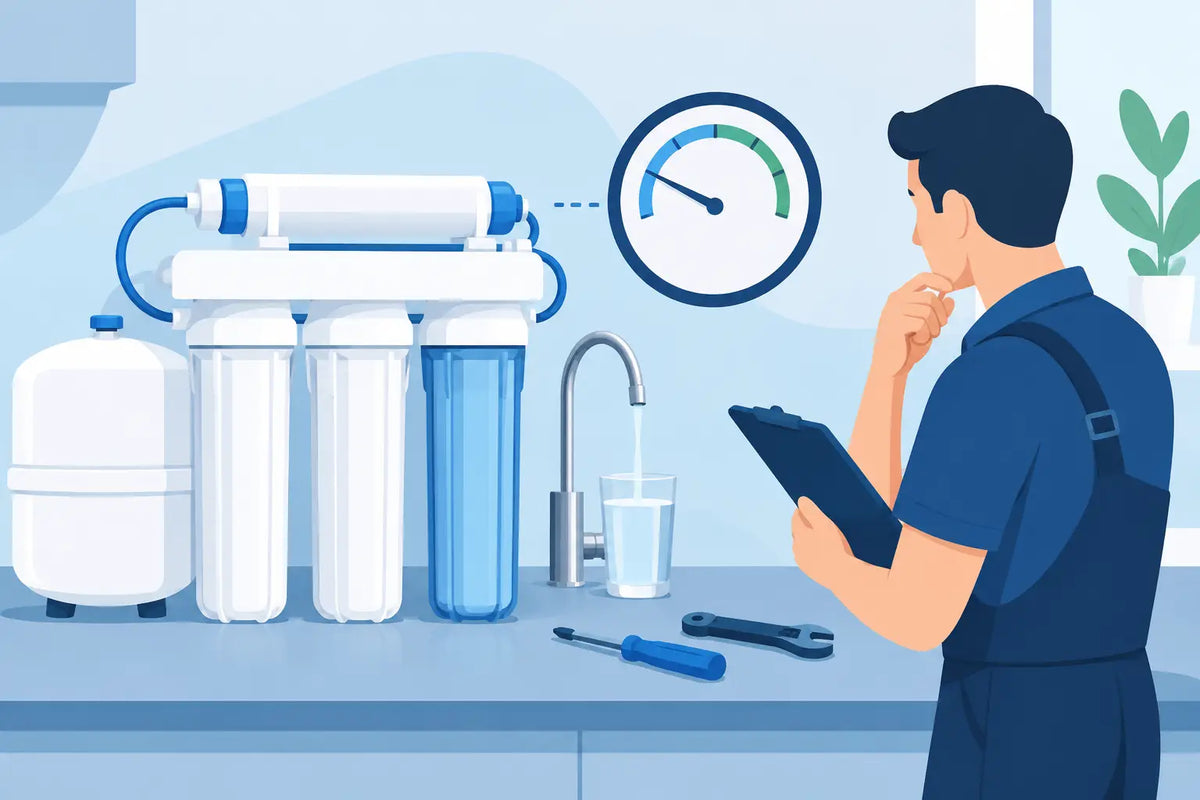
A reverse osmosis faucet that slows to a trickle can turn a glass of water into a waiting game. When you troubleshoot low reverse osmosis pressure, the goal is to identify whether the issue is water entering the system, water being produced by the membrane, or water leaving the storage tank. Those are very different problems, and replacing parts at random can waste both time and money.
Most residential RO systems produce water slowly by design, then store it in a pressurized tank for on-demand use. A sudden drop in faucet flow usually points to the tank, a filter, a valve, or the faucet itself. A system that never seems to refill may have insufficient feed pressure, overdue cartridges, or a membrane that has reached the end of its service life.
First, identify what “low pressure” means
Before disconnecting anything, notice the pattern. If the faucet begins with a decent stream but quickly fades, the storage tank is likely not holding enough usable water. If the faucet has a weak flow from the first second even after the tank has had hours to refill, look at the post-filter, faucet, tank valve, or tank air charge.
If the RO system produces very little water over an entire day, the restriction is more likely on the incoming-water side. Clogged sediment or carbon filters, low household water pressure, a damaged membrane, or a cold-water supply can all reduce production.
Also compare the RO faucet with a regular cold-water faucet. If pressure is low throughout the home, the RO system may not be the source of the problem. A well pump issue, pressure regulator setting, plumbing restriction, or municipal supply problem needs attention first.
Troubleshoot low reverse osmosis pressure step by step
Work from the simplest checks to the more technical ones. Turn off the tank valve and the incoming feed-water valve before opening filter housings or disconnecting tubing. Keep a towel and shallow pan nearby, since a small amount of water release is normal.
Check the tank valve and tubing
A partially closed tank valve can cause an immediate low-flow complaint. Confirm that the valve on top of the storage tank is fully open, with the handle aligned with the tubing. Inspect the tubing for sharp bends, pinches behind cabinetry, loose connections, or a section compressed by stored items under the sink.
Next, confirm that the feed-water valve supplying the system is fully open. Saddle valves used on older installations can clog or fail to open completely. If the system has worked reliably for years and the feed valve is questionable, replacing it with a proper adapter valve is often a more dependable long-term repair.
Replace overdue pre-filters
Sediment and carbon pre-filters protect the RO membrane, but they become restrictive as they collect sediment, rust, chlorine byproducts, and other contaminants. A clogged pre-filter can reduce the pressure reaching the membrane, which directly reduces the amount of purified water the system can make.
For many homes, sediment and carbon filters should be replaced every 6 to 12 months. The right interval depends on water quality and water use. Homes on private wells, homes with visible sediment, and busy households may need more frequent service. Do not wait for a complete loss of flow. Reduced production, unusual taste, or a noticeably longer tank refill time are practical signals that service is due.
If your system uses quick-connect cartridges rather than filter housings, make sure each replacement cartridge is fully seated. An improperly installed cartridge may restrict flow or allow a small leak that interferes with normal operation.
Test the storage tank air charge
The RO tank contains a bladder and a small air chamber. That air charge pushes stored water to the faucet. When the charge is too low, the tank may feel heavy with water but deliver only a weak stream. When it is too high, the tank may hold very little water at all.
To check it correctly, first shut off the feed-water valve. Open the RO faucet and let the tank drain completely. Water should stop flowing before you test the air pressure at the Schrader valve on the bottom or side of the tank. Testing with water still in the tank will not give an accurate result.
Most standard residential RO tanks should read about 5 to 7 psi when empty, but verify the recommendation for your specific tank. Use a low-pressure tire gauge, then add air in very small increments with a hand pump if needed. Avoid using a high-pressure compressor. If water comes out of the air valve, the internal bladder has failed and the tank should be replaced.
Inspect the post-filter and RO faucet
A post-carbon filter improves the final taste of RO water, but it can become a flow restriction when it is old or clogged. This is especially likely if the tank is known to be full yet faucet flow remains weak. Replace the post-filter according to its service schedule, commonly every 6 to 12 months.
The faucet can also be the culprit. Mineral deposits or debris may clog the small air gap, internal screen, or spout opening. If the system tank delivers strong flow when tubing is briefly disconnected downstream of the tank, but flow is weak through the faucet, clean or replace the faucet. Use care when testing disconnected tubing, as a full tank can release water quickly.
Consider membrane condition and feed-water pressure
The membrane is the heart of the system, but it is not always the first part that needs replacement. A membrane usually lasts 2 to 5 years, depending on incoming water quality, filter maintenance, chlorine exposure, and usage. A worn membrane typically causes slow tank recovery and poorer water quality rather than only weak faucet flow.
Feed-water pressure matters just as much. Most residential RO systems perform best with at least 40 psi of incoming pressure, and many benefit from 50 to 60 psi. Below that range, the membrane cannot efficiently separate contaminants and produce purified water. Homes on well systems, upper floors of multi-story buildings, and locations with low municipal pressure may need a booster pump.
Cold water also slows production. In winter, a system can take noticeably longer to refill because colder water moves through the membrane more slowly. That is normal to a degree. But if winter performance is dramatically worse, low feed pressure or clogged pre-filters may be amplifying the seasonal effect.
Signs a valve or automatic shutoff needs attention
A reverse osmosis system uses an automatic shutoff valve to stop production when the tank is full. When this valve sticks or fails, the system may run continuously to the drain, refill poorly, or behave inconsistently. A check valve near the membrane housing can create similar symptoms when it leaks backward.
These components are more difficult to diagnose without observing water flow through the system. Warning signs include a steady drain line long after the tank should be full, a tank that never fully fills, or cycling sounds under the sink. If filters, tank pressure, and feed pressure check out, valve service is the logical next step.
For systems with a permeate pump, inspect that pump and its tubing as well. A failed permeate pump can reduce tank fill performance, particularly where feed-water pressure is marginal.
When low flow means it is time to replace a component
Replace filters when their service interval has passed or when they are visibly dirty and restricting production. Replace a storage tank when its bladder has failed, it cannot hold the proper air charge, or it delivers very little water despite correct pressure. Replace the membrane when production remains low after filter service and adequate incoming pressure are confirmed, especially if a water-quality test shows declining rejection performance.
Avoid assuming a larger tank is always the answer. A larger tank provides more stored water for a busy household, but it will not fix low feed pressure, a clogged filter, or a failing membrane. Likewise, a booster pump can improve production but should be matched to the system and installed correctly.
Commercial and light-industrial RO equipment adds other variables, including pretreatment capacity, pump performance, pressure switches, flow controls, and higher daily water demand. In those applications, pressure and flow readings should be documented before changing parts so the root cause is clear.
Get the system back to dependable performance
A properly maintained RO system should provide clean drinking water without a weak, frustrating faucet stream. Start with the tank valve, tubing, and filter service history, then check the empty tank air charge and incoming water pressure. This sequence resolves many household RO flow problems without unnecessary part replacements.
If the diagnosis points to a new tank, membrane, booster pump, or complete replacement system, Pure Water Guys can help match the solution to your water conditions, household demand, and existing setup. Clean water should be ready when your family reaches for it.