
October 16, 2026
Top Filters for Microplastics That Actually Work
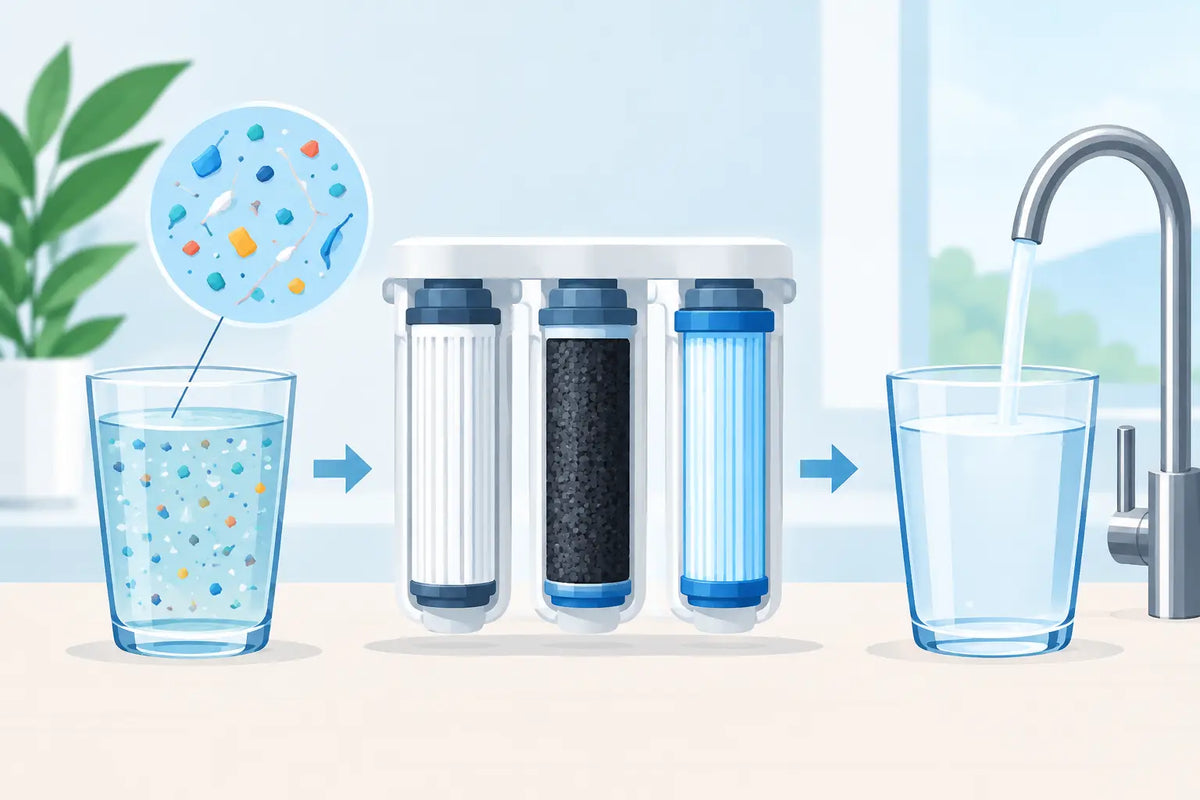
A glass of clear water can still contain particles too small to see. That is why homeowners searching for the top filters for microplastics need more than a basic taste-and-odor filter. The right solution depends on where you want protection, what else is in your water, and how much treated water your household needs each day.
Microplastics are plastic particles that can enter water supplies through runoff, wastewater, packaging, pipes, and household sources. Research and testing methods are still developing, particularly for the smallest particles often called nanoplastics. But one fact is clear: a filtration system must physically separate very fine particles to provide meaningful microplastic reduction.
For most families, reverse osmosis at the kitchen sink is the strongest starting point for drinking and cooking water. For whole-home planning, a layered system that combines sediment filtration, carbon filtration, and targeted membrane treatment where needed is usually the more practical answer.
What Makes a Filter Effective for Microplastics?
A filter's micron rating matters, but it is not the only number that matters. A micron is one-millionth of a meter. Larger microplastics may be captured by fine sediment filters, while smaller particles require a much tighter barrier, such as an ultrafiltration or reverse osmosis membrane.
Filter design also matters. A nominal rating means a filter captures a stated percentage of particles at a given size. An absolute rating is more stringent and indicates more consistent particle removal at that size. Neither description alone proves performance against every type or size of microplastic, so look at the complete system rather than relying on one label.
Water pressure, flow rate, cartridge condition, and installation quality also affect results. A system that is overdue for maintenance cannot protect water as designed. Replacement schedules are part of the filtration system, not an optional extra.
The Top Filters for Microplastics at Home
Reverse osmosis systems
Reverse osmosis, commonly called RO, is generally the best choice for reducing a broad range of very small particles in drinking water. An RO membrane uses extremely fine separation to reject many contaminants, including dissolved solids and particles much smaller than what ordinary sediment filtration can reliably catch.
This makes an under-sink reverse osmosis system a strong fit for water used for drinking, cooking, coffee, ice, infant formula, and pet bowls. Most RO systems also include sediment and carbon prefilters. Those stages protect the membrane from sediment and chlorine while improving taste and odor.
The trade-off is that RO systems produce a limited amount of concentrate water during treatment and typically require a dedicated faucet, storage tank, or tankless configuration. They are designed for point-of-use protection, not for every shower and appliance in the home. For many households, that is exactly the right balance: premium filtration where water is consumed most.
Ultrafiltration systems
Ultrafiltration, or UF, is another membrane-based option. UF membranes have pores small enough to reduce suspended solids, sediment, cysts, bacteria, and many larger microplastic particles. Unlike reverse osmosis, ultrafiltration generally does not remove dissolved minerals, so it can preserve the natural mineral content of the source water.
A UF system can be a good choice when the water is already low in dissolved contaminants but you want fine particle reduction without the wastewater associated with traditional RO. It is particularly useful for customers who prefer a higher flow rate or want to retain minerals.
The limitation is pore size. Because RO membranes are tighter than UF membranes, reverse osmosis is typically the better choice when the goal is the broadest possible reduction of very fine particles alongside contaminants such as lead, PFAS, nitrate, or dissolved solids. The right selection depends on your water report and the contaminants you need to address.
Fine sediment filtration
Fine sediment cartridges are a valuable first line of defense, especially for visible particles, sand, rust, silt, and larger plastic fragments. A 1-micron or 5-micron sediment filter can protect downstream equipment and improve the performance of carbon filters, UV systems, and membranes.
Sediment filtration alone should not be treated as a complete microplastic solution. It may capture larger particles, but it cannot provide the same level of protection against the smallest particles that can pass through a comparatively open filter media. Its best role is as part of a multi-stage system.
For homes on private wells or homes with noticeable sediment, a properly sized whole-house sediment filter is often essential before adding finer treatment. A cartridge that clogs too quickly can reduce water pressure and create unnecessary maintenance costs, so capacity matters as much as micron rating.
Activated carbon filtration
Activated carbon is excellent for reducing chlorine, unpleasant tastes, odors, and many organic compounds. It can also improve the overall drinking experience and protect certain membrane technologies from chlorine damage.
However, carbon should not be selected as the primary filter for microplastics. Carbon works mainly through adsorption, while microplastics are physical particles of varying sizes and shapes. A carbon block may catch some particles as water passes through its structure, but performance is not as predictable as a membrane designed for fine physical separation.
Carbon is still an important stage in a complete system. In an RO unit, for example, carbon prefiltration supports membrane performance. In a whole-house system, carbon can make shower water and tap water more pleasant while helping address chlorine exposure throughout the home.
Whole-House Filtration vs. Drinking Water Filtration
Homeowners often ask whether microplastic protection should begin at the main water line. The answer depends on your goals.
A whole-house filtration system treats water used for showers, laundry, bathrooms, appliances, and every faucet. It is a smart choice when your home has sediment, chlorine, iron, sulfur, or other water-quality concerns that affect the full property. A whole-house sediment stage can also reduce larger particulate matter before water reaches fixtures and equipment.
But whole-house membrane filtration can be more complex and costly because it must deliver enough flow for multiple bathrooms, appliances, and peak household demand. A small under-sink RO system can focus high-level filtration on a few gallons of drinking water per day. Treating every gallon to that same standard requires more system capacity, planning, and maintenance.
For many homes, the most efficient approach is a combination: whole-house sediment and carbon filtration for broad water quality improvement, paired with reverse osmosis at the kitchen sink for drinking and cooking water. This layered design protects the family, supports appliances, and avoids paying for intensive membrane treatment on water that will be used for showers or laundry.
How to Choose the Right System
Start with the source of your water. Municipal water may contain chlorine or chloramine, while private well water can bring sediment, iron, manganese, sulfur, or bacteria concerns. Those conditions affect which prefilters are necessary and how frequently they will need service.
Next, consider the water you use most for consumption. If your primary goal is cleaner drinking water, an under-sink RO system is usually the clearest value. If you have cloudy water, visible sediment, or frequent clogged aerators, begin with whole-house sediment filtration and build from there.
Also consider household size and available space. A family of five needs a system with enough daily production and storage capacity to avoid running short during busy mornings. Tankless RO systems can save cabinet space, while traditional tank systems can offer dependable stored water during periods of higher use.
Finally, do not buy based on a single claim. Ask what the system is designed to reduce, what replacement filters cost, how often service is required, and whether your water pressure and plumbing support the installation. For commercial kitchens, offices, multifamily properties, and facilities, system sizing should account for peak flow, source-water conditions, and the volume of water required each day.
Keep Your Protection Performing
Even the best filtration technology needs timely maintenance. Change sediment and carbon filters according to the manufacturer schedule, or sooner if pressure drops or your source water is especially dirty. Replace membranes when their performance declines, and sanitize drinking water systems when recommended.
If you are unsure whether you need reverse osmosis, ultrafiltration, or a whole-house setup, start with the problem you want solved and the water you want protected. Pure Water Guys can help match a practical system to your source water, household demand, and budget, so you can move from concern to a clear filtration plan.
The best filter is not necessarily the most complicated one. It is the system that reliably treats your water, fits your home, and stays maintained long after installation day.