
September 26, 2026
RO Wastewater Ratio: What a Better Number Means
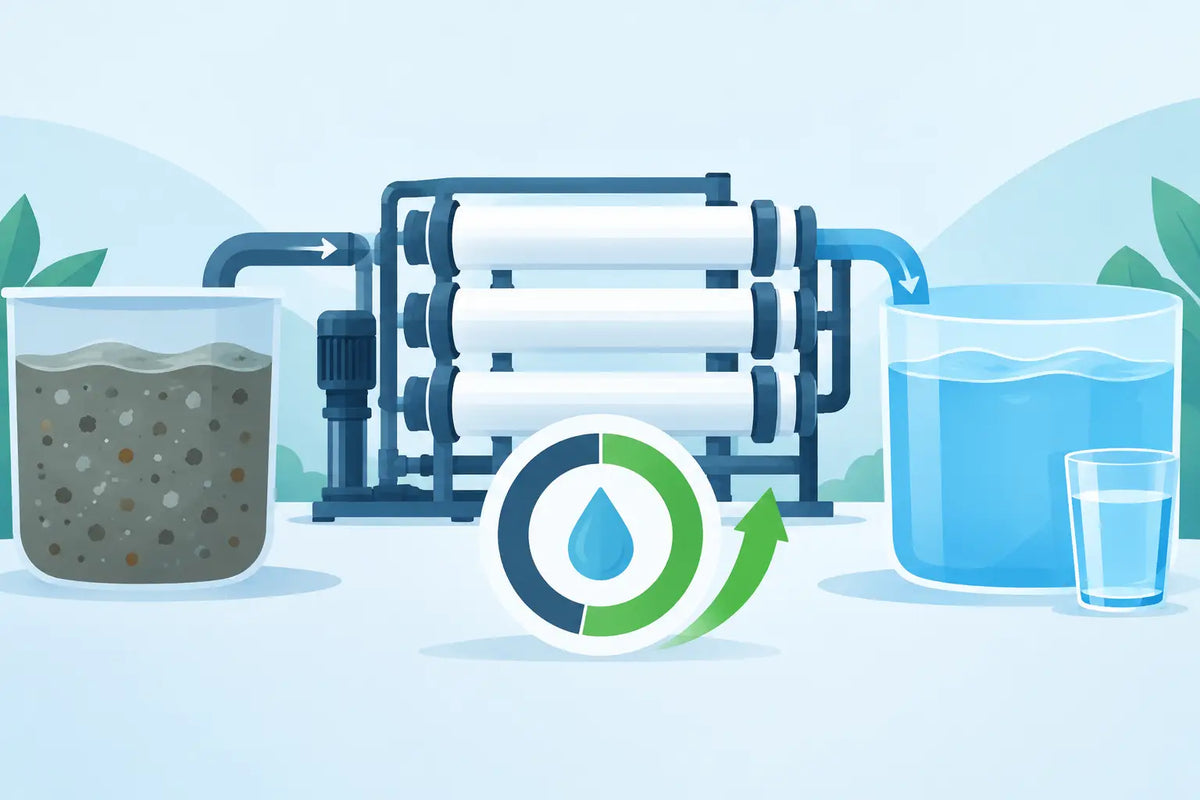
A reverse osmosis system can make a noticeable difference in the water your family drinks, but it also sends some water to the drain as it cleans the membrane. The RO wastewater ratio tells you how much. Understanding that number helps you compare systems honestly, manage water use, and avoid sacrificing water quality for a marketing claim.
What Is an RO Wastewater Ratio?
An RO system separates incoming water into two streams. The first is permeate, or the purified water collected in the storage tank or delivered through a tankless system. The second is concentrate, often called reject water or wastewater. This stream carries away the dissolved minerals, salts, and contaminants that the membrane did not allow into your drinking water.
The RO wastewater ratio expresses the relationship between those two streams. In most residential product descriptions, it is shown as wastewater to purified water.
For example, a 3:1 ratio means the system sends approximately three gallons to the drain for every gallon of purified water it produces. A 1:1 ratio means it produces about one gallon of purified water for every gallon discharged.
Lower wastewater is generally desirable, but the lowest advertised number is not automatically the best system for every home. An RO membrane needs enough flow across its surface to rinse away concentrated contaminants. Too little flushing can lead to faster membrane fouling, reduced output, and weaker long-term performance.
Why Reverse Osmosis Systems Produce Wastewater
Reverse osmosis is designed to reduce a broad range of dissolved contaminants, including many minerals, heavy metals, nitrates, and PFAS when the system is appropriately rated for them. Water pressure pushes feed water against a tightly wound semipermeable membrane. Purified water passes through the membrane, while a concentrated portion continues to the drain.
That drain flow is part of the process, not a sign that the system is malfunctioning. It helps prevent dissolved solids from building up on the membrane surface. Without it, scale and contaminant concentration could damage the membrane or shorten its useful life.
This is the trade-off behind every RO wastewater ratio: better efficiency matters, but membrane protection and contaminant reduction matter too. A system should be designed to balance all three.
Common Residential RO Ratios
Older or basic under-sink RO systems often operate around 3:1 or 4:1. That means they may use three to four gallons of feed water to make one gallon of purified water. These systems can still provide excellent drinking water, especially when properly maintained, but they are less efficient than newer designs.
Many modern systems are designed around a 2:1 or 1:1 ratio. High-efficiency tankless RO systems may claim 1:1, 2:1, or even more favorable ratios under ideal test conditions. These models typically use improved membrane technology, electric booster pumps, and carefully engineered flow controls to produce water more efficiently.
The operating conditions matter. A ratio listed on a specification sheet is often measured with a particular feed-water pressure, temperature, and total dissolved solids level. Your actual result may vary.
What Changes Your Actual RO Wastewater Ratio?
Your home's water is not a laboratory test. Several factors affect how efficiently an RO system runs from day to day.
Feed-water pressure is one of the biggest. Reverse osmosis relies on pressure to move purified water through the membrane. Homes with low pressure may see slower production and less favorable water efficiency. A system with a booster pump can help maintain the pressure needed for more consistent performance.
Water temperature also matters. Cold water moves through an RO membrane more slowly than warm water. That is why output commonly drops during colder months, especially in regions with cold incoming municipal water or well water.
Your feed-water quality plays an equally important role. Hard water, high total dissolved solids, iron, manganese, sulfur, and sediment can all increase the burden on a membrane. Pretreatment is not optional in these situations. A water softener, sediment filter, iron filter, or other properly selected system can protect the RO unit and support better efficiency.
Finally, maintenance affects the ratio. Clogged prefilters restrict flow. A worn membrane can lose production capacity. An aging tankless system pump or an incorrectly installed flow restrictor can also create performance issues. Replacing filters on schedule protects both water quality and water use.
A Low Ratio Is Good, but It Is Not the Only Buying Factor
When comparing reverse osmosis systems, a 1:1 wastewater ratio can be appealing, especially for families focused on conservation or households with higher drinking-water demand. It can reduce the amount of water sent to the drain compared with a conventional 3:1 or 4:1 design.
Still, compare more than the ratio. A high-efficiency system should also have a credible contaminant-reduction claim, sufficient daily production for your household, appropriate filtration stages, and replacement filters that are readily available. A low-waste system that cannot keep up with demand or is not suited to your water chemistry is not a good value.
For a small household using RO water mainly for drinking, coffee, cooking, and pet bowls, a conventional tank-style system may be perfectly practical. For a large family, a busy office, or a customer who fills reusable bottles throughout the day, a tankless RO system with a higher gallons-per-day rating may be the better fit.
Commercial and light industrial applications require a different level of analysis. System recovery, membrane recovery limits, feed-water chemistry, pretreatment, peak demand, and local discharge requirements all matter. Pushing recovery too high can cause scaling and costly membrane replacement. Proper commercial RO design protects the equipment first, then targets water efficiency within safe operating limits.
How to Reduce RO Water Waste Responsibly
The best way to reduce wastewater is to start with a system designed for your needs and install it correctly. Trying to modify an existing unit by changing or removing its flow restrictor can damage the membrane and undermine water quality. The concentrate line is engineered to provide necessary flushing.
If your current system uses a 3:1 or 4:1 ratio and you want a more efficient upgrade, look for a modern RO system with a booster pump and a documented 1:1 or 2:1 performance rating. For homes with low water pressure, the pump is especially valuable because it can improve both production rate and efficiency.
Good maintenance also makes a real difference. Replace sediment and carbon prefilters according to the manufacturer schedule, sanitize the system when recommended, and replace the RO membrane when its performance declines. If you notice slow flow, reduced production, or a change in taste, test the system rather than assuming the problem is only the storage tank or faucet.
Some homeowners ask whether RO reject water can be reused. In limited cases, it may be usable for non-potable tasks such as cleaning or irrigation, but caution is necessary. Reject water contains concentrated dissolved solids and any contaminants rejected by the membrane. It is not suitable for drinking, food preparation, or sensitive plants, and it should never be reused if the source water contains contaminants that could create a safety concern. Local plumbing rules may also apply.
Choose an RO System Around Your Water, Not Just a Ratio
The right RO system begins with the reason you want filtration. Is your concern chlorine taste, high TDS, lead, PFAS, nitrate, well-water contaminants, or a mix of issues? A water test and an honest review of household demand make the decision much clearer.
At Pure Water Guys, we help customers look beyond a single specification. A well-matched reverse osmosis system should deliver dependable purified water, fit the available space, meet daily demand, and use water responsibly without compromising membrane life.
A better RO wastewater ratio can lower water use, but protected water quality is the real goal. Choose a system built for your source water and maintain it well, and every glass from the faucet can feel like a more confident choice.