
August 27, 2026
Commercial Water Treatment System Guide for Buyers
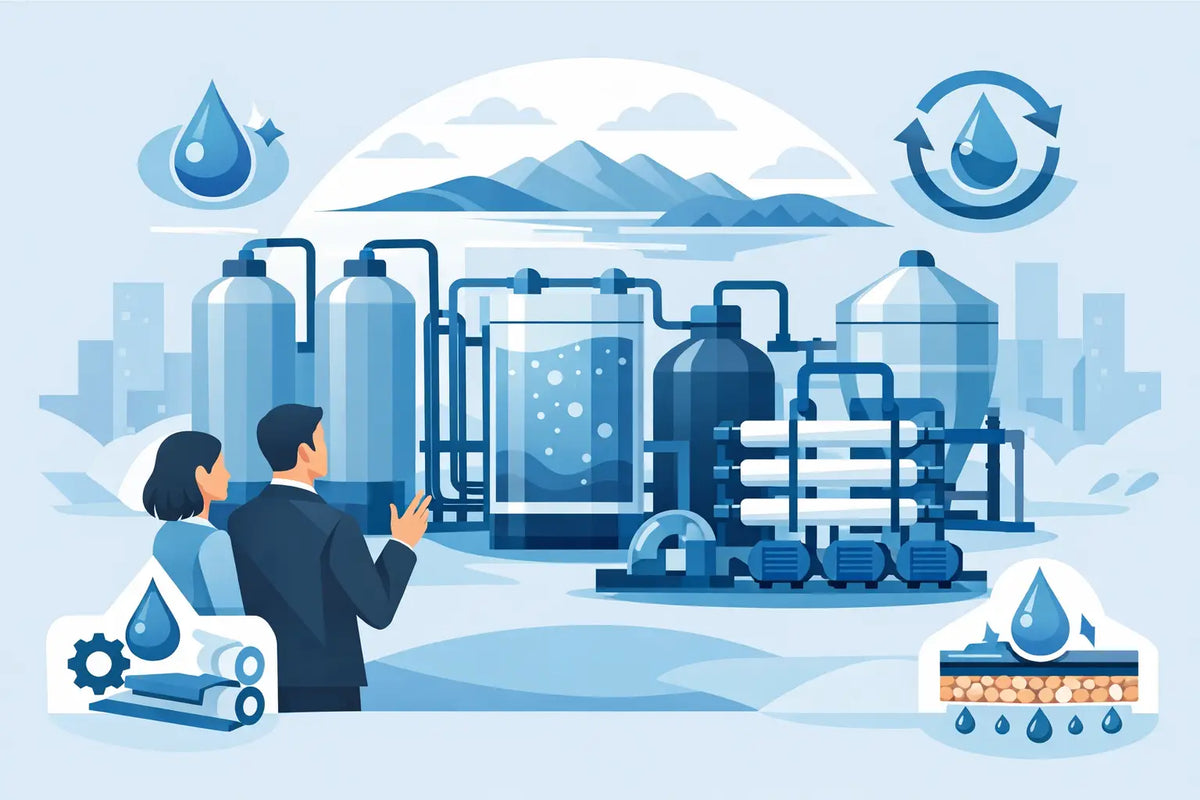
A restaurant’s ice machine starts producing cloudy cubes. A boiler room begins consuming more energy. Guests complain about coffee taste, or a lab needs consistent feedwater to protect sensitive equipment. These are not one-size-fits-all problems, which is why a commercial water treatment system guide should begin with the water, the application, and the daily demand - not a product catalog.
Commercial treatment is about protecting people, equipment, product quality, and operating costs at the same time. The right system can reduce scale, improve taste, control contaminants, and keep operations moving. The wrong one can create pressure loss, frequent service calls, premature cartridge changes, or water that still fails to meet the facility’s needs.
Start With the Water Problem and the Business Use
A water report is the starting point for every serious commercial project. Municipal water and private well water can both change by location, season, plumbing conditions, and source. A basic report may show hardness, iron, manganese, pH, chlorine or chloramine, total dissolved solids (TDS), turbidity, and bacteria indicators. Depending on the business, testing for PFAS, lead, arsenic, nitrate, sulfur, or other local concerns may also be appropriate.
Just as important is where and how the water will be used. A café may need scale control and better-tasting water for espresso, ice, and steam equipment. A multi-family property may be focused on reducing hard-water damage across many fixtures. A food service operation may need reliable prefiltration and reverse osmosis for specific equipment, while a laboratory may require tightly controlled water quality at a dedicated point of use.
Do not assume that “clean water” means the same thing in every setting. Carbon filtration can improve chlorine taste and odor, but it does not soften hard water. A water softener addresses calcium and magnesium, but it is not designed to remove dissolved salts, PFAS, or microbiological contamination. Each treatment method solves a different problem.
Know Your Flow Rate, Peak Demand, and Space Limits
Commercial systems must be sized for real operating conditions, not average use alone. A system that works well during a quiet afternoon may struggle when a restaurant is filling ice bins, washing dishes, and serving drinks at the same time. For whole-building applications, peak flow rate in gallons per minute is often the critical sizing number. For reverse osmosis, daily production and the rate at which treated water must be delivered both matter.
Ask practical questions early: How many fixtures or pieces of equipment need treated water? Is demand steady or concentrated into short windows? Does the system need to serve one appliance, a kitchen line, or an entire building? Is there room for tanks, pretreatment vessels, storage, and service access?
Pressure is another overlooked factor. Filtration media, cartridges, membranes, and plumbing all create pressure drop. A system needs enough incoming pressure to deliver usable flow after treatment. If pressure is limited, a booster pump, larger vessel, or different configuration may be needed.
Plan for Installation and Service Access
The least expensive equipment is not always the least expensive installation. Commercial water treatment may require floor drains, electrical service, bypass plumbing, backwash discharge, storage tanks, or a dedicated equipment pad. Reverse osmosis systems also produce concentrate water that must be managed according to local plumbing requirements.
Leave room to change cartridges, add salt, inspect controls, and service tanks. Equipment packed into an inaccessible closet can turn routine maintenance into a costly disruption. A good design protects the building as well as the water.
Commercial Water Treatment System Guide: Core Technologies
Most commercial systems combine technologies rather than relying on one device. The best combination depends on the contaminants, flow rate, end use, and maintenance capacity.
Sediment and Multimedia Filtration
Sediment filtration captures sand, silt, rust, and other particles. It is especially valuable for well water, aging plumbing, or water with visible turbidity. Cartridge filters are common for point-of-use or moderate-flow applications, while backwashing multimedia filters are often a better fit for larger flows or heavier sediment loads.
The trade-off is simple: finer filtration can improve water clarity but may require more frequent cartridge changes or create greater pressure drop. Pretreatment must be matched to the actual particle load.
Carbon Filtration
Activated carbon reduces chlorine, many taste-and-odor compounds, and certain organic contaminants. It is a familiar choice for restaurants, office drinking water, hospitality, and applications where chlorine can damage reverse osmosis membranes.
Carbon is not permanent. Its performance depends on contact time, water chemistry, flow, and media capacity. For municipal systems using chloramine, standard carbon may not provide sufficient reduction without the proper media and sizing.
Water Softeners and Scale Control
Hard water forms scale on heating elements, steam equipment, dishwashers, water heaters, and plumbing. Conventional ion-exchange softeners remove hardness minerals and are often the strongest choice where scale prevention is critical. They require salt and periodic regeneration, which means planning for brine storage and drain access.
Salt-free scale-control systems can be appealing where salt handling or discharge is a concern. However, they do not remove hardness minerals, and results depend heavily on the water chemistry and application. For demanding boiler, steam, or high-temperature equipment, true softening may be the more dependable option.
Reverse Osmosis Systems
Commercial reverse osmosis (RO) reduces a broad range of dissolved contaminants, including TDS, many metals, and other dissolved compounds. RO is commonly used for drinking water, specialty beverage applications, spot-free rinsing, and equipment that requires lower-mineral feedwater.
RO requires thoughtful pretreatment. Sediment, chlorine or chloramine, hardness, iron, and biological fouling can shorten membrane life if not addressed first. It also uses water to flush away concentrated contaminants, so recovery rate, storage capacity, production rate, and local discharge requirements should be reviewed before installation.
UV Water Treatment
Ultraviolet treatment disinfects water by inactivating microorganisms when the water has adequate clarity and receives the proper UV dose. It is often considered for private wells, food service, and facilities with microbiological concerns.
UV does not remove sediment, chemicals, or dissolved minerals. It is typically installed after filtration, because cloudy water can shield organisms from the light. Lamp replacement and sleeve cleaning are part of ongoing ownership.
Build Treatment in the Right Order
System sequence matters. A common commercial arrangement is sediment reduction first, then carbon or specialty media, followed by softening if needed, with RO or UV placed where the application calls for it. The exact order changes with the source water and equipment requirements.
For example, an RO system supplied by hard, chlorinated municipal water may need sediment filtration, carbon treatment, and softening before the membranes. A well-water system with iron and bacteria may require oxidation or iron reduction, filtration, softening, and UV. Skipping pretreatment can make an expensive final-stage system perform poorly.
Treat only the water that needs treatment when that approach makes sense. A whole-building softener may be the right answer for a hotel or apartment property, while a dedicated RO system at a beverage station may be more efficient than producing RO water for every faucet in the building.
Compare Ownership Costs, Not Just Purchase Price
The purchase price is only one part of the decision. Budget for replacement cartridges, filter media, softener salt, UV lamps, membrane replacement, water use during regeneration or RO flushing, testing, and scheduled service. Higher-capacity systems may cost more upfront but reduce labor and downtime in a high-demand facility.
Reliability also has financial value. A failed ice machine, scaled combi oven, or unexpected closure tied to water quality can cost far more than proper pretreatment. Ask how long consumables are expected to last at your projected volume, what service tasks are required, and whether replacement parts are readily available.
Certification and compliance deserve attention as well. When a facility has a specific water-quality requirement, verify that the system and components are appropriate for the claim being made. Treatment equipment is not a substitute for required monitoring, local code compliance, or a facility’s own safety procedures.
Get a System Specification Before You Buy
A commercial system should be specified from usable data: a recent water analysis, desired treatment goals, peak and daily demand, incoming pressure, available footprint, drain and electrical access, and the equipment being protected. This information allows a specialist to choose vessel sizes, media, cartridge capacity, membrane output, controls, and storage that fit the job.
At Pure Water Guys, commercial projects can be matched with quote-based system guidance rather than forcing a complex application into a generic package. That support matters when a facility needs more than a standard filter housing.
Bring your water report, equipment list, and operating schedule into the conversation. The right commercial treatment system should feel less like a guess and more like a practical utility - built to protect the operation every day it is needed.