
July 04, 2026
Reverse Osmosis vs Ultrafiltration
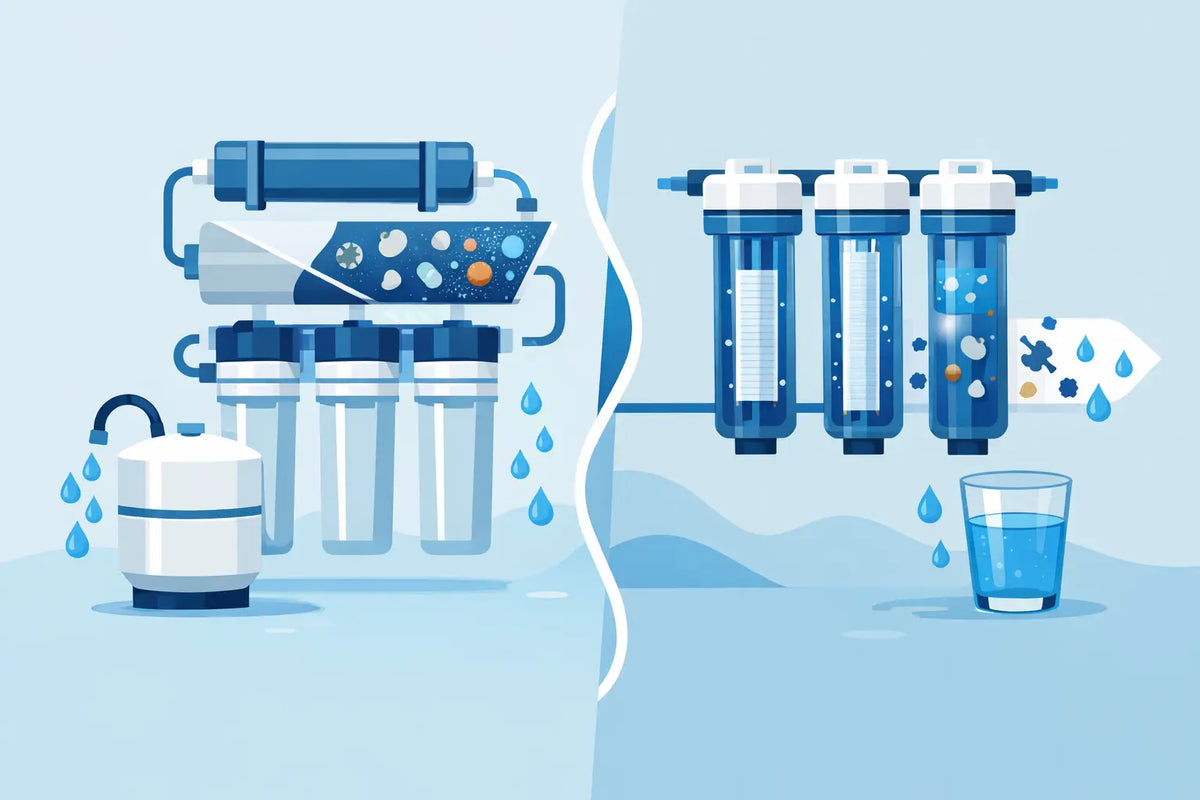
If you are comparing reverse osmosis vs ultrafiltration, you are probably past the point of wanting a generic "better water" promise. You want to know what each system actually removes, where each one fits, and which choice protects your family, equipment, or business without paying for capacity you do not need.
That is the right question to ask, because reverse osmosis and ultrafiltration are not interchangeable. They may both improve water quality, but they solve different problems and they do it in very different ways.
Reverse osmosis vs ultrafiltration: the core difference
The simplest way to separate these technologies is by what their membranes are designed to block. Reverse osmosis uses a much tighter membrane than ultrafiltration. That tighter membrane can reduce dissolved contaminants such as salts, heavy metals, nitrates, fluoride, and many other impurities that are small enough to pass through less restrictive filtration.
Ultrafiltration, by contrast, is designed to stop larger particles and organisms. It is very effective for sediment, turbidity, many bacteria, and some larger contaminants, but it does not remove dissolved solids the way reverse osmosis does. If the issue in your water is something dissolved, ultrafiltration usually is not the complete answer on its own.
That difference matters more than any marketing label. If your water has PFAS concerns, high total dissolved solids, or a strong need for drinking water purity at the point of use, reverse osmosis is often the better fit. If your goal is preserving minerals, improving clarity, and filtering certain larger contaminants with higher flow and less wastewater, ultrafiltration can make a lot of sense.
How reverse osmosis works
A reverse osmosis system pushes water through a semi-permeable membrane under pressure. That membrane allows water molecules through while rejecting a wide range of dissolved contaminants. Most residential systems also include prefilters and postfilters, often with sediment and carbon stages, because membrane performance depends on proper pretreatment.
This layered design is why reverse osmosis drinking water systems are popular for under-sink use. They are built to address taste, odor, lead, fluoride, arsenic, nitrates, and other dissolved contaminants that basic carbon filters may miss. The result is very clean water for drinking and cooking.
The trade-off is that reverse osmosis is slower than simpler filtration and usually creates some reject water during the purification process. It also removes beneficial minerals along with unwanted dissolved solids, which some homeowners like and others do not.
How ultrafiltration works
Ultrafiltration also uses a membrane, but with larger pore sizes than reverse osmosis. Instead of targeting dissolved ions and very small molecular contaminants, it focuses on suspended solids, colloids, and many microorganisms. That makes it useful when the main concern is physical contamination or microbial reduction rather than dissolved chemistry.
In practical terms, ultrafiltration can be a strong option for homes or facilities that want low-maintenance filtration with strong flow and no need to strip out minerals. It can also be valuable as part of a larger treatment train, especially where sediment, cloudiness, or biological contamination are part of the water profile.
Because ultrafiltration does not reject dissolved salts and similar contaminants, it should not be selected just because it sounds advanced. If your lab report shows elevated TDS, sodium, nitrates, or other dissolved issues, ultrafiltration alone is unlikely to solve the problem.
What contaminants each system removes
This is where the buying decision usually becomes clearer.
Reverse osmosis is the stronger option for dissolved contaminants. Depending on system design and water conditions, it can reduce total dissolved solids, fluoride, arsenic, nitrates, lead, chromium, and many other dissolved impurities. It is also widely used where taste and odor problems are tied to a broader water quality issue rather than chlorine alone.
Ultrafiltration is stronger where the concern is larger material in the water. Think sediment, turbidity, some bacteria, and suspended particles. It can improve visual clarity and microbiological quality, but it will not give you the same dissolved contaminant reduction as reverse osmosis.
That is why water testing matters. Two households can both say they want safer water, but one may need dissolved contaminant reduction at the kitchen sink while the other mainly needs better particulate filtration for well water or a pretreatment stage for a commercial setup.
Reverse osmosis vs ultrafiltration for homes
For most homeowners, the real question is not which technology is more impressive. It is which one matches the water problem at the point where you actually use the water.
If your city water has chlorine taste, possible lead concerns from plumbing, fluoride, or elevated dissolved solids, reverse osmosis is often the right drinking water solution. It is especially popular for under-sink installation because it targets the water you drink and cook with most directly.
If your goal is broader filtration with less water waste and better flow, ultrafiltration can be appealing. Some homeowners prefer it because it keeps beneficial minerals in the water and does not require a storage tank in the same way many RO systems do. That said, if your water report points to dissolved contamination, those benefits do not outweigh the need for the right treatment technology.
Whole-house applications are a separate conversation. Reverse osmosis can be used for whole-home or light commercial treatment, but it requires more planning, storage, drainage, and system sizing. Ultrafiltration may be used in larger-scale filtration setups too, often as one part of a multi-stage system rather than a standalone answer to every water issue.
Which system costs more to own
Reverse osmosis usually carries a higher total cost of ownership than ultrafiltration, especially when you factor in membrane replacement, prefilter changes, storage components, and wastewater. It also may require a booster pump in lower-pressure situations.
Ultrafiltration systems are often simpler and can be more efficient in day-to-day use. They generally waste less water and may have fewer supporting components, which can mean lower maintenance complexity.
Still, lower operating cost does not automatically make ultrafiltration the better value. A system is only cost-effective if it solves the actual problem. Spending less on the wrong filtration technology usually means paying twice.
Maintenance and performance trade-offs
Every water filter works best when it is matched to the application and maintained properly.
Reverse osmosis membranes are sensitive to fouling, so pretreatment matters. Sediment and chlorine can shorten membrane life if the system is not set up correctly. Homeowners who stay on top of filter changes usually get strong performance, but neglected maintenance can reduce flow and contaminant reduction.
Ultrafiltration membranes also need maintenance, but the routine can be simpler depending on the design. They are often valued for strong flow rates and lower wastewater production. In the right conditions, that makes them practical for users who want dependable filtration without the footprint or operating profile of RO.
The key is that performance claims mean very little without context. Source water quality, incoming pressure, daily usage, contaminant type, and system sizing all affect how well either technology performs.
How to choose between reverse osmosis and ultrafiltration
If your priority is high-purity drinking water and reduction of dissolved contaminants, reverse osmosis is usually the stronger choice. If your priority is filtering larger particles and microorganisms while maintaining minerals and flow, ultrafiltration may be the better fit.
For homeowners, the easiest way to decide is to start with your water problem, not the product category. Bad taste alone could point to carbon filtration, not necessarily RO or UF. Cloudy water suggests a different solution than high nitrates. PFAS concerns often require a more targeted strategy. Well water and city water also create very different treatment paths.
For businesses, especially restaurants, facilities, and light industrial users, system selection is even more dependent on water chemistry and application demands. Equipment protection, production consistency, and regulatory expectations all shape whether RO, UF, or a combination approach makes sense.
That is why many customers do best with guidance instead of guesswork. A good supplier does not just sell a membrane system. They help match the treatment method to the actual risk, the flow requirement, and the budget.
There is no prize for choosing the more complex system. The smart choice is the one that addresses your specific contaminants, fits your property, and stays reliable over time. If you are weighing reverse osmosis vs ultrafiltration, start with what is in your water and what you need the system to do. From there, the right answer becomes much easier to see.