
June 08, 2026
How Do Whole Home Water Filtration Systems Work?
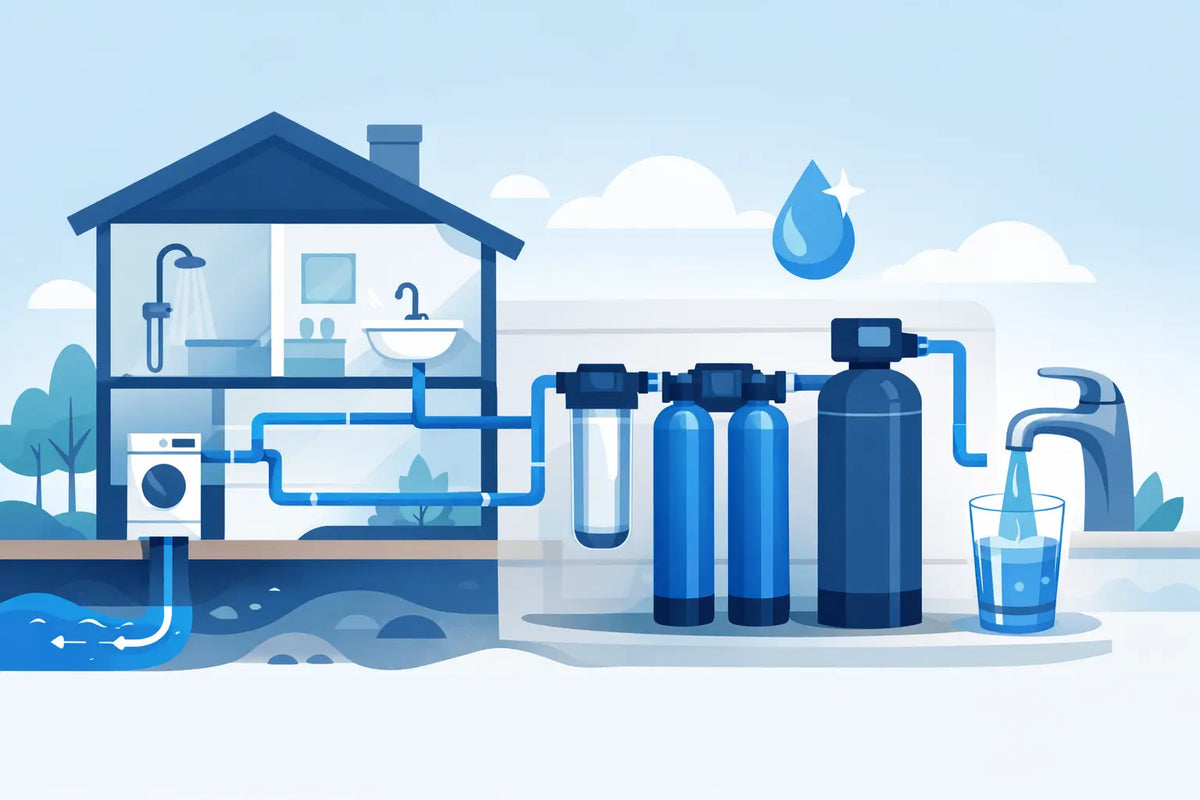
If your shower smells like chlorine, your dishes spot up, or your tap water leaves you second-guessing what your family is using every day, the question becomes practical fast: how do whole home water filtration systems work, and what exactly are they doing once they are installed? A whole home system treats water at the point where it enters the house, so the water going to your showers, sinks, laundry, and appliances is filtered before it gets distributed.
That sounds simple, but the way a system works depends entirely on the problem it is built to solve. Some homes need chlorine and sediment reduction. Others need help with iron, sulfur, hard water, PFAS, or bacteria. The right system is less about buying a generic tank and more about matching the filtration method to your water.
How whole home water filtration systems work at the entry point
A whole home filtration system is usually installed on the main water line after the water meter or pressure tank and before the plumbing branches off to the rest of the property. This placement matters because it allows the system to treat nearly all the water entering the home instead of filtering just one faucet.
In most cases, water passes through one or more treatment stages in sequence. The first stage often handles larger particles like sand, dirt, rust, or debris. After that, the water may move through specialized media designed to reduce chlorine, chloramines, bad taste, odor, iron, sulfur, or certain organic compounds. Some systems also add a final stage such as ultraviolet disinfection or a water softener, depending on the source water and the household's needs.
Think of it as a treatment train rather than a single filter. Each stage has a job, and the system works best when those jobs are arranged in the right order.
What happens inside the tanks and filter housings
From the outside, many whole house systems look straightforward - a prefilter housing, one or more tanks, and a control valve. Inside, the treatment is more specialized.
A sediment prefilter usually catches visible particles before they can clog the main media bed. This stage protects downstream equipment and is especially useful for well water or older municipal plumbing.
A carbon filter is one of the most common whole home components. Activated carbon works by adsorbing contaminants onto its surface. That makes it effective for reducing chlorine, many taste and odor problems, and some volatile organic compounds. If your main complaint is chemical smell or water that tastes like a swimming pool, carbon is often the core technology.
Backwashing media tanks work a little differently from replaceable cartridge filters. Water flows through a bed of treatment media, and on a schedule, the system reverses flow to lift and rinse the media bed. This helps clear trapped particles and maintain performance. Not every whole home system backwashes, but when it does, it can reduce maintenance and extend media life.
Some homes also need ion exchange. This is how traditional water softeners remove hardness minerals like calcium and magnesium. Technically, softening is not the same thing as filtration, but it is often paired with whole home filtration because many households are dealing with both aesthetic and scaling issues at the same time.
How do whole home water filtration systems work for different water problems?
This is where many buyers get tripped up. A whole home water filtration system is not one universal machine that removes everything equally well. It depends on the contaminant.
For municipal water, the most common concern is chlorine or chloramine disinfection byproducts, along with taste, odor, and sediment. In that case, a sediment stage paired with carbon filtration is often enough to improve water quality throughout the house.
For well water, the picture is more variable. One home may have iron staining and sulfur smell. Another may have tannins, manganese, sediment, or bacterial risk. Those issues often require specialized media, oxidation stages, or UV sterilization. A basic carbon tank alone usually will not solve all of that.
PFAS is another example where details matter. Some systems are designed specifically to reduce PFAS, but performance depends on media type, contact time, flow rate, and whether the filtration is whole home, point of use, or both. Many households use a whole home system for broad treatment and then add reverse osmosis at the kitchen sink for highly targeted drinking water reduction.
Hard water is different again. If your problem is scale buildup on fixtures, shortened appliance life, and soap not rinsing well, a softener or salt-free conditioner may be part of the solution. Filtration and conditioning are related, but they solve different problems.
The role of flow rate, tank size, and contact time
A whole home system only works well if it can keep up with your house. That means sizing matters.
When water moves too quickly through a filter, the media may not have enough time to reduce contaminants effectively. This is called contact time. Larger homes, multi-bath properties, and light commercial settings often need bigger tanks or higher-capacity systems so treatment stays effective during peak use.
Flow rate also affects the user experience. An undersized system can create pressure drop, especially if several fixtures run at once. That is why a one-size-fits-all approach tends to disappoint. A good setup considers household size, number of bathrooms, peak gallons per minute, and the actual water conditions at the property.
This is also why system recommendations should start with water data whenever possible. A lab test, municipal water report, or at minimum a clear list of symptoms gives much better guidance than choosing by price alone.
Maintenance is part of how the system works
Whole home filtration is not install-and-forget equipment. Ongoing maintenance is part of the operating design.
Cartridge prefilters need regular replacement. Carbon media and specialty media have a service life and eventually need rebedding or tank replacement. Backwashing systems need power and drainage, and softeners need salt if they use conventional ion exchange. UV systems need lamp changes on schedule to remain effective.
None of that means high hassle, but it does mean the system only protects your water when it is maintained properly. The good news is that the maintenance schedule is usually predictable once the system is sized correctly and matched to the water problem.
For homeowners, this comes down to two questions: what has to be changed, and how often? For property managers and commercial operators, it also includes downtime, service access, and replacement cost over time. Those practical details matter just as much as the filtration claim.
What whole home systems do well and where they have limits
Whole home systems are excellent for broad protection. They can improve water quality at every tap, reduce sediment and chemical exposure, protect plumbing and appliances, and make bathing and cleaning more comfortable.
They also have limits. Most whole home systems are not meant to produce ultra-purified drinking water in the same way a dedicated reverse osmosis system can. They may reduce certain contaminants house-wide, but if your top priority is drinking water purity for a specific contaminant, a point-of-use system may still make sense in addition to whole home treatment.
There is also a cost trade-off. A more comprehensive system brings better coverage, but it also means higher upfront investment and ongoing maintenance. For some households, a simpler sediment and carbon setup is the right fit. For others, especially with private well water or known contamination concerns, a more engineered multi-stage system is worth it.
Choosing the right system for your home or facility
The best way to approach whole home filtration is to start with the problem, not the product. Are you trying to remove chlorine? Protect plumbing from sediment? Solve rotten egg odor? Address PFAS concerns? Manage hard water? Support a restaurant, office, or multi-use property with higher demand?
Once the water issue is clear, the right technology becomes much easier to identify. Municipal and well water need different strategies. A family of five in a two-bath house needs a different flow profile than a commercial kitchen. Even two homes on the same street can need different systems if one has older plumbing, higher usage, or different water quality goals.
That is where expert guidance helps. PureWaterGuys works with homeowners and businesses that need more than a generic recommendation, especially when the goal is matching the right whole home system to a specific water condition, property size, and budget.
A well-chosen whole home filtration system should feel almost invisible once it is in place. The water smells cleaner, fixtures stay in better shape, appliances get more protection, and you stop wondering what is flowing through every tap in the building. That peace of mind is usually the real reason people start looking in the first place.