
July 02, 2026
Carbon Filter vs Reverse Osmosis: Which Fits?
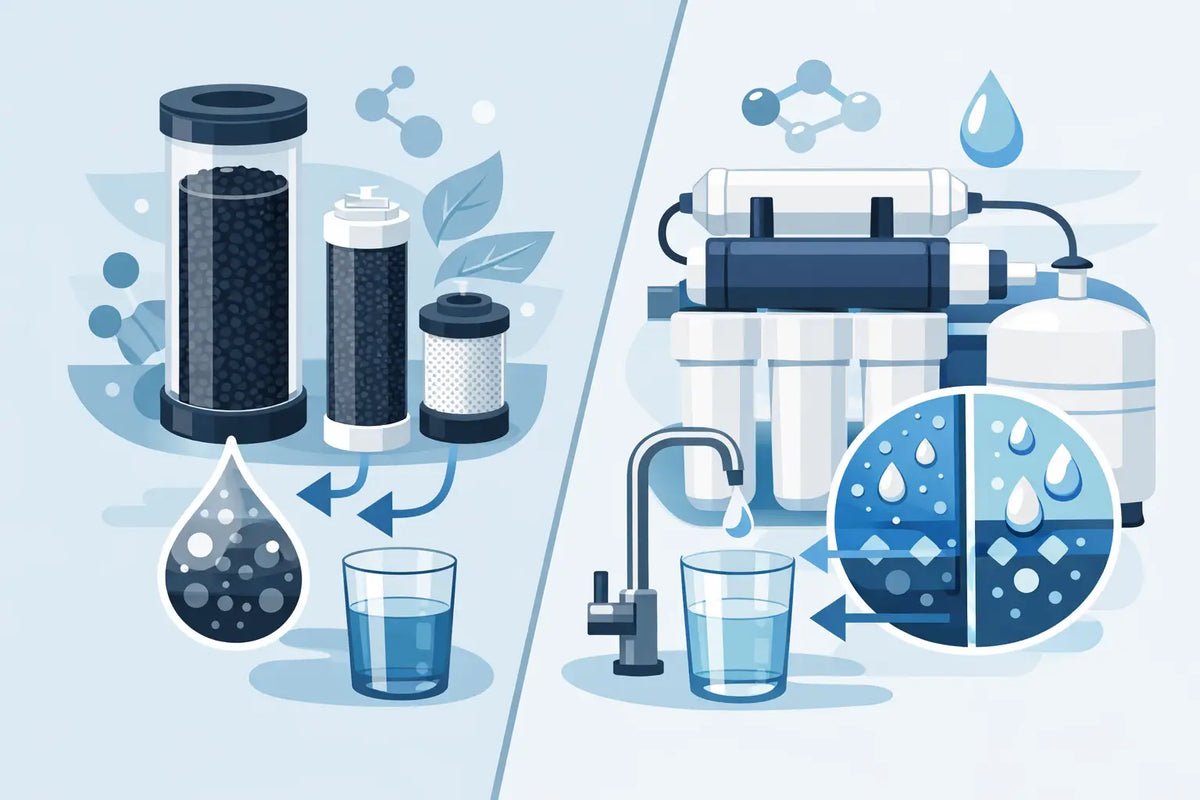
If your water smells like chlorine, tastes flat, or leaves you wondering what is actually coming out of the tap, the carbon filter vs reverse osmosis question usually comes up fast. Both are proven filtration methods, but they solve different problems. Choosing the right one depends on what is in your water, how much protection you want, and whether you are treating one faucet or an entire property.
For many homeowners, the decision starts with a simple goal - better tasting, safer drinking water. For businesses and facilities, the stakes can be higher because water quality can affect equipment, food and beverage quality, and customer experience. The right answer is not whichever system sounds more advanced. It is the one that matches your water conditions and your use case.
Carbon filter vs reverse osmosis: the core difference
A carbon filter is primarily an adsorption system. Activated carbon traps certain contaminants on its surface, making it especially effective for chlorine, many volatile organic compounds, and the taste and odor issues that make city water unpleasant to drink.
Reverse osmosis, often called RO, is a membrane-based filtration process. Water is pushed through a semi-permeable membrane that rejects a much wider range of contaminants, including many dissolved solids, heavy metals, nitrates, fluoride, and many PFAS compounds when the system is properly designed.
That difference matters. If your biggest complaint is chlorine taste from municipal water, a carbon filter may be all you need. If you are trying to reduce dissolved contaminants that carbon alone does not reliably remove, reverse osmosis is usually the stronger choice.
What a carbon filter does well
Carbon filtration earns its place because it addresses some of the most common water complaints quickly and cost-effectively. In homes on city water, chlorine and chloramine can create an obvious chemical taste and odor. Carbon is often the first line of defense for making water more pleasant to drink and cook with.
It can also reduce many organic compounds that affect smell and taste. That is one reason carbon is widely used in under-sink systems, refrigerator filters, countertop units, and whole house filtration setups.
There is also a practical side. Carbon systems are usually simpler, lower in cost, and easier to maintain than reverse osmosis. They do not require a drain connection in the same way an RO system does, and they typically preserve stronger water flow. For whole-home applications, carbon is often the more realistic solution because reverse osmosis for an entire house is more specialized, more expensive, and not necessary for most households.
Still, carbon has limits. It does not remove everything, and it is not the right tool for every contamination concern.
Where carbon filtration falls short
Carbon is not a catch-all technology. It is generally not the best standalone solution for high total dissolved solids, salts, many dissolved metals, or hardness. If your water has elevated arsenic, nitrates, or a high mineral load, carbon by itself is usually not enough.
This is where many buyers get tripped up. A filter can improve taste dramatically while leaving dissolved contaminants largely unchanged. Better taste is valuable, but it is not the same as broad contaminant reduction.
What reverse osmosis does well
Reverse osmosis is the better fit when you need deeper drinking water treatment. A quality RO system is designed to reduce a broad spectrum of dissolved contaminants that carbon alone cannot reliably handle. That includes many heavy metals, fluoride, nitrates, and total dissolved solids.
For families focused on health protection, RO often brings peace of mind because it goes well beyond cosmetic improvements like taste and odor. It is also a strong option for people dealing with specific water test results, especially when those results show contaminants that require membrane filtration rather than simple adsorption.
In commercial settings, RO can be even more important. Restaurants, coffee programs, labs, and facilities often need tighter control over mineral content and dissolved contaminants to protect outcomes and equipment performance. In those cases, reverse osmosis is not just about drinking quality. It can be part of process control.
Most residential RO systems also include pre-filters and post-filters, often with carbon stages built in. That means the comparison is not always carbon or RO in a strict sense. In many systems, carbon supports RO by removing chlorine before water reaches the membrane and polishing taste after treatment.
Where reverse osmosis falls short
Reverse osmosis is more thorough, but it is not always the simpler or cheaper answer. It usually costs more upfront, requires more installation planning, and produces some reject water during filtration. Depending on the system, water production can also be slower than a standard carbon filter.
RO is typically used at a single point of use, such as under the kitchen sink, rather than for the entire home. If your only concern is chlorine taste at the tap, RO may be more system than you need. It can also remove beneficial minerals along with unwanted dissolved solids, which some users prefer to add back with a remineralization stage.
Carbon filter vs reverse osmosis for common water problems
If you are deciding between the two, the fastest way to narrow it down is to start with the problem you are trying to solve.
For chlorine taste and odor, carbon is usually the clear winner on value. It is effective, affordable, and widely used for exactly that purpose.
For PFAS concerns, the answer depends on the specific system and certification, but reverse osmosis is often chosen when stronger reduction is the goal. Certain carbon filters can also target PFAS, so this is one area where product design matters more than broad category labels.
For lead, fluoride, nitrates, and high TDS, reverse osmosis is usually the better fit.
For whole-house treatment, carbon often makes more sense because it can treat higher flow rates and larger volumes without the complexity of whole-house RO. If the goal is better water throughout the home for showering, cooking, and general use, a whole house carbon system may be the right first step. Then, if you want higher-purity drinking water at the kitchen sink, an under-sink RO can handle that final point-of-use need.
That combination is common because it reflects how people actually use water. Not every gallon needs the same level of treatment.
Cost, maintenance, and daily use
A carbon filter is usually easier on the budget, both upfront and over time. Cartridge changes are straightforward, and the systems themselves are often compact and simple to operate.
Reverse osmosis requires more components, and that means more to maintain. Pre-filters, post-filters, and the membrane all have service intervals. None of that is unusual, but it is important to understand before buying. The better question is not whether RO needs maintenance. It does. The real question is whether the added contaminant reduction justifies that maintenance for your water profile.
Daily use matters too. A family filling water bottles and cooking from one kitchen faucet may find RO ideal. A property owner who wants cleaner water at every fixture may be better served by a whole house carbon system, sometimes paired with other technologies for sediment, hard water, or UV disinfection depending on the source water.
The best choice depends on your water source
Municipal water and well water create different decision paths.
On municipal water, carbon filtration is often a strong first move because chlorine and disinfection byproducts are common concerns. If your water report or testing also shows PFAS, lead, fluoride, or other dissolved contaminants, reverse osmosis may be the more protective drinking water upgrade.
On well water, the decision can be more complex. Carbon may help with certain taste and odor issues, but wells often present challenges like iron, manganese, sulfur, sediment, bacteria, or hardness that require other targeted treatment. Reverse osmosis can play a role at the point of use, but it usually should not be your first and only answer for untreated well water. Pretreatment is often essential.
That is why testing matters. Water treatment works best when the system is matched to the actual problem instead of a guess.
When a combined approach makes the most sense
For many homes and businesses, the smartest answer in the carbon filter vs reverse osmosis debate is both, used in the right places. A whole house carbon filter can improve water quality across the property by reducing chlorine and odor. An under-sink reverse osmosis system can then provide higher-purity water for drinking and cooking.
This layered approach is practical, not excessive. It keeps whole-property treatment efficient while reserving deeper purification for the tap where it matters most. It also gives buyers more flexibility with budget and installation.
For customers who want help sorting through those choices, Pure Water Guys focuses on matching systems to actual water problems rather than pushing a one-size-fits-all fix.
How to make the right call
If your goal is cleaner taste, easier maintenance, and a lower upfront cost, a carbon filter is often the right place to start. If your goal is broader contaminant reduction for drinking water, reverse osmosis is usually worth the upgrade.
If you are dealing with PFAS, lead, nitrates, fluoride, or high dissolved solids, do not choose based on marketing alone. Choose based on testing, certifications, and the specific contaminants you need to reduce. And if you need better water throughout the home plus stronger drinking water protection at one tap, a combined setup often delivers the best balance.
Good water treatment is not about buying the most complicated system. It is about putting the right solution in the right place so your family, your property, or your business gets dependable protection every day.